FATF Launches Targeted Review of Virtual Asset Standards: What It Means for VASPs
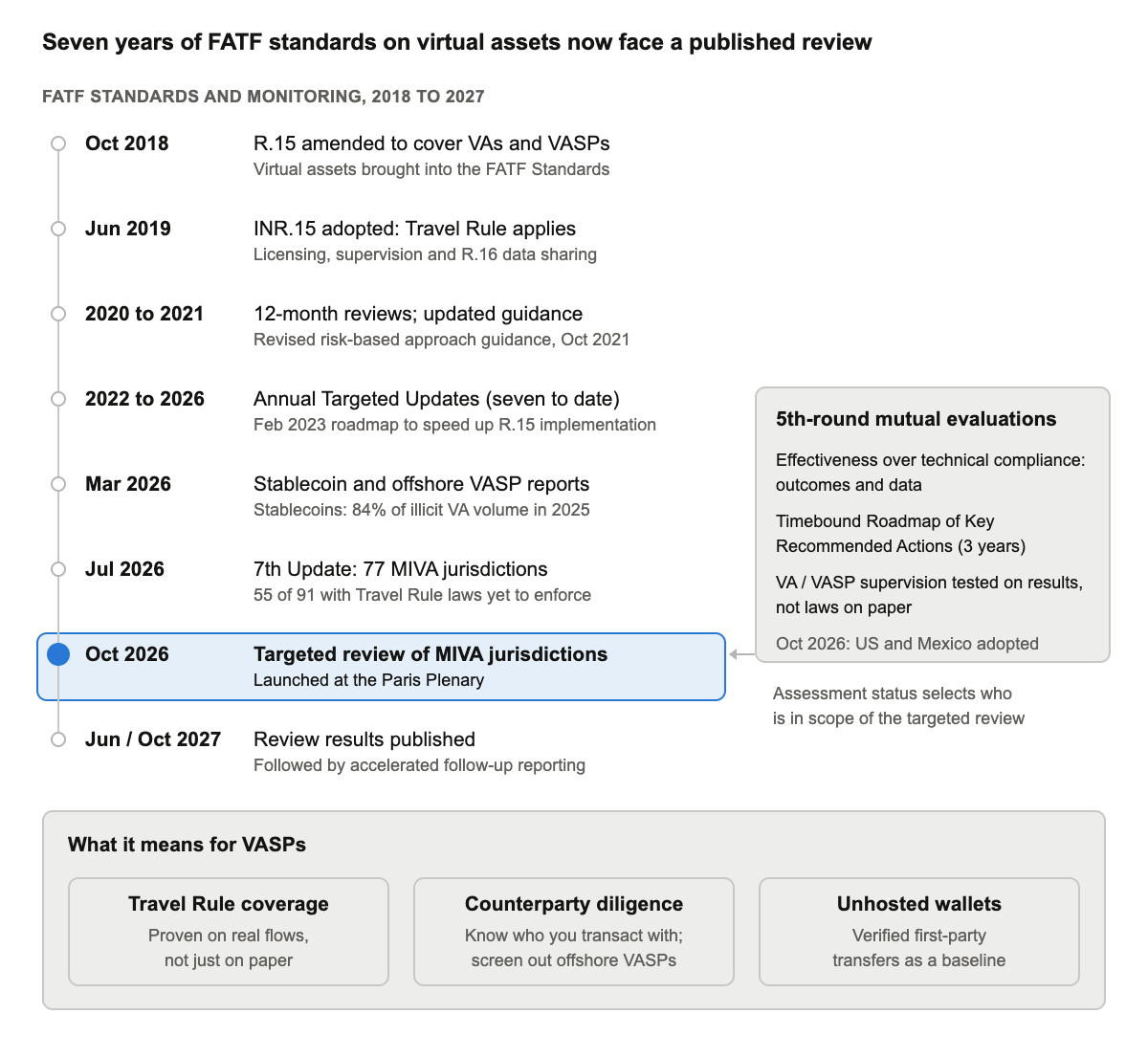
On 30 October 2026, the FATF announced a targeted review of how jurisdictions implement its standards on virtual assets and VASPs, with first results due in June 2027.
Seven years after the 2019 revisions to Recommendation 15, implementation across the global network is still uneven, and criminal networks continue to exploit the gaps. The FATF is no longer content to wait for the regular, multi-year mutual evaluation cycle and its annual targeted update to catch up.
For regulators, VASPs, and compliance officers therein, this marks a shift from guidance to accountability.
What the FATF announced
The targeted review was agreed at the October 2026 Plenary in Paris (28–30 October), the first held under the UK Presidency of Giles Thomson. It responds directly to the FATF Ministerial Declaration of April 2026 made on the sideline of IMF/World Bank meeting.
The key elements:
• Who is in scope: primarily jurisdictions with materially important VASP activity (MIVA), selected on the basis of their current assessment status.
• How they are chosen: the FATF says selection will rest on objective criteria.
• What follows: the review is paired with follow-up monitoring and an accelerated reporting process, so identified deficiencies are tracked rather than left to the next evaluation round.
• When: initial results will be published in June 2027, with further results in October 2027.
FATF is tightening the trip to nudge jurisdictions for accountability, transparency and timely action through publications that will bring those lagging behind visible to the international stage, their peers and the market.
Why now
The Plenary pointed to criminals' growing use of virtual assets for fraud, scams, sanctions evasion, money laundering, terrorist financing and proliferation financing. The review is the latest step in a year of escalating FATF warnings that we have tracked closely:
• Stablecoins and unhosted wallets (March 2026). The FATF's Targeted Report on Stablecoins and Unhosted Wallets found stablecoins accounted for 84% of illicit transaction volume in 2025, much of it moving peer-to-peer outside any obliged intermediary. Read our analysis.
• Offshore VASPs (March 2026). The FATF's report on offshore VASPs showed only 46% of jurisdictions apply an activity-based licensing approach, and named fragmented Travel Rule implementation, the "Sunrise Issue", as a key blind spot. Read our analysis.
• Seventh Targeted Update (July 2026). The 2026 Targeted Update expanded the MIVA list to 77 jurisdictions, covering about 97% of the global virtual asset market. It also found that 55 of the 91 jurisdictions with Travel Rule legislation had yet to take any Travel Rule supervisory or enforcement action. Read our analysis.
• The Global Fraud Issue. The new UK FATF President Giles Thomson has named Tackling Fraud his number 1 priority. In 2025, the global losses related to financial fraud reached an estimate of over US$400 billion. Read our analysis at the Global Fraud Summit.
It is clear that laws are on the books, but FATF is not content with the effectiveness metrics - supervision and enforcement. The new process changes the incentive. Instead of another report urging all countries to move faster, MIVA jurisdictions now face a published, time-bound review with follow-up attached.
What it means for VASPs
The review targets jurisdictions, not individual firms, and it sets no new deadline for VASPs per se. But pressure on regulators trickles down. VASPs in MIVA jurisdictions should expect supervisors to tighten expectations well in the coming months.
Singapore offers a preview. In July 2026, the Monetary Authority of Singapore published an Information Paper on AML/CFT Supervisory Expectations for DPTSPs, drawn from its inspections and backed by 10 case studies. It shows what a supervisor tests once Travel Rule laws are in place. Read our analysis.
Where that pressure is likely to land:
- Travel Rule (R.16) coverage in practice, not on paper. In one MAS case study, a DPTSP's solution covered only a small share of its actual transfers because it did not support the token or the counterparty sat outside its network. Supervisors will measure coverage against real flows.
- Counterparty due diligence. MAS is explicit that DPTSPs cannot rely solely on their Travel Rule solution to identify and verify counterparty VASPs. The FATF's offshore VASP report likewise urges firms to assess exposure to unlicensed providers and detect oVASPs posing as retail customers.
- Unhosted wallets and non-obliged counterparties. MAS cites limiting transfers to verified first-party transactions as a risk mitigant. With stablecoins dominating illicit flows through unhosted wallets, expect this to become a baseline control. See our stablecoin analysis.
- Interoperability. MAS lists interoperability among its six guiding factors for evaluating a Travel Rule solution. Fragmented messaging between protocols is one of the biggest practical gaps behind the Sunrise Issue.
- Data for FIUs and law enforcement. The value of the Travel Rule is the trail it leaves. Records must be retrievable and usable when authorities ask.
Firms operating across several jurisdictions should plan for the strictest regime. Published results will shape how international and local regulators and banking partners view each market.
Our view
At VerifyVASP, we welcome the FATF's move from encouragement to accountability. Uneven implementation is not just a theoretical regulatory problem. Every jurisdiction that lags creates a weak link that fraudsters and other criminals and illicit funds will find, and that weak link costs compliant VASPs, FIUs and law enforcement time and resources.
The Travel Rule only works when it works everywhere. That means VASPs, regulators and solution providers sharing the same goal: fast, secure and verifiable data exchange that gives authorities the information they need to follow the money on-chain. It is why our Verified Network starts with legal-entity due diligence on every counterparty, and why we have mapped it against MAS' six guiding factors.
The June 2027 results are eight months away (two plenary cycles). VASPs that use this time to test their Travel Rule flows end to end, close counterparty gaps and document their decisions will be ready for whatever their regulators ask next.
Talk to us about how VerifyVASP helps VASPs meet FATF Recommendations across jurisdictions.