Following the Money, at Speed: What FATF's New Scam-compound Principles Mean for the Travel Rule
Scams are now an industrial business, and the Financial Action Task Force (FATF) has said plainly that the response has to move at the same speed as the money. Two recent publications set the agenda.
On 5 November 2026 the FATF published a 90-page report entitled Combating End-to-End Illicit Financial Flows Linked to Scam Compounds, with nearly 120 case studies from more than 60 jurisdictions and six new FATF principles for disrupting scam compounds. This follows FATF’s earlier publication of its FATF Anti-Fraud Toolkit which maps how its 40 Recommendations already equip countries to fight fraud: risk assessment, international cooperation, public-private partnerships, virtual asset regulation, payment transparency and asset recovery.
Consistent with our observations at the Global Fraud Summit 2026, the latest publications name virtual assets as a central laundering channel. That puts the Travel Rule (Recommendation 16) at the centre of the answer. It is the one control that already makes VASPs exchange identity data on every qualifying transfer, across borders, in real time. Read against the new principles, it is an essential element of the shared fraud-fighting infrastructure, not a compliance checkbox.
The scale of the problem
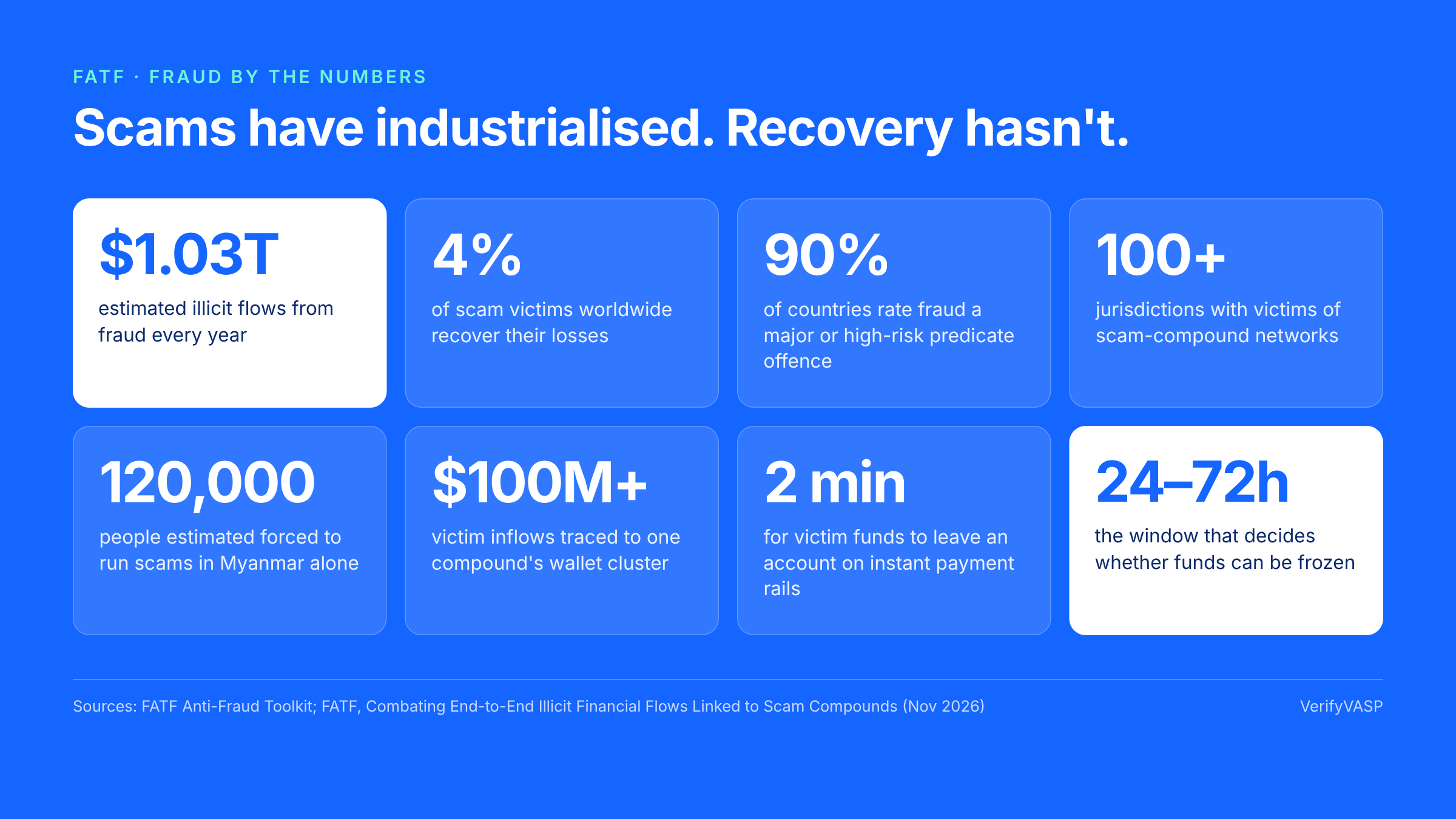
Fraud generates an estimated USD 1.03 trillion in illicit flows a year, yet only 4% of scam victims ever recover their losses. In the latest round of FATF mutual evaluations, 90% of countries rated fraud a major or high-risk predicate offence.
Scam compounds are the engine behind much of this. The FATF documents them across Africa, Europe, the Americas and Asia, with victims in more than 100 jurisdictions and an estimated 120,000 people forced to run scams in Myanmar alone. In one case, blockchain analysis traced more than USD 100 million in victim payments to a single wallet cluster tied to one compound. Some compounds even run their own OTC desks on site to swap virtual assets and move funds domestically.
Speed is the criminals' advantage: on instant payment rails, victim funds can leave an account in as little as two minutes.
Six principles, one data layer
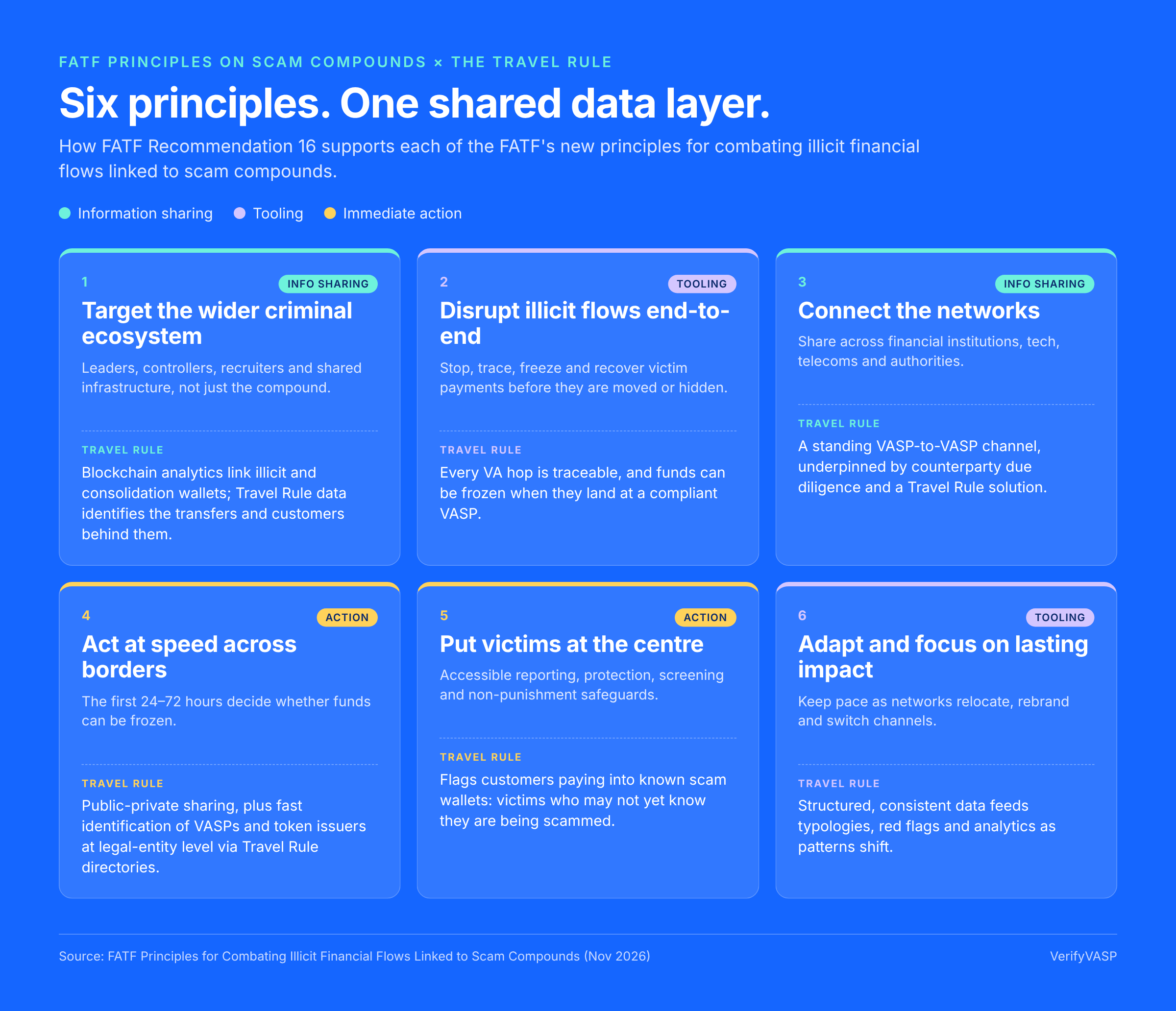
The FATF's six principles for combating scam-compound financial flows all depend on knowing who sent funds and who received them. That is exactly the data the Travel Rule makes VASPs collect, verify and pass on.
|
FATF
principle |
What
it asks for |
Where
the Travel Rule helps |
|
1. Target the wider criminal ecosystem |
Go after leaders, controllers, recruiters and shared
infrastructure, not just the physical compound |
Blockchain data can link illicit wallet addresses and
identify consolidation wallets. Travel Rule will help identify any transfers
linked to these wallets. |
|
2. Disrupt illicit financial flows end-to-end |
Stop, trace, freeze and recover victim payments before
they are moved or hidden |
Each VA hop along the trail is traceable and when it can
be frozen when it lands in a compliant exchange. |
|
3. Connect the networks |
Share information between financial institutions, tech,
telecoms and authorities |
A standing VASP-to-VASP information-sharing and support
channel is underpinned by stringent counterparty due-diligence and support by
a Travel Rule solution (FATF Requirement of Travel Rule solutions) |
|
4. Act at speed across borders |
The first 24 to 72 hours decide whether funds can be
frozen |
PPP information sharing and commitment from VASPs coupled
with ability for law enforcement to identify VASPs or token issuers at legal
entity level (supported by Travel Rule solution with such information) |
|
5. Put victims at the centre |
Accessible reporting, protection and safeguards |
Identifying victims (who do not know they are scammed) if
they have assets flowing into known wallet addresses associated with scams |
|
6. Adapt and focus on lasting impact |
Keep pace as networks relocate, rebrand and swap channels |
Structured, consistent data feeds typologies, red flags
and analytics as patterns shift |
Information sharing: the Travel Rule is already a network
The Toolkit calls for rapid information sharing between public and private sectors, and the scam-compound report asks authorities to connect financial, technology and telecoms intelligence. In virtual assets, much of that pipe already exists.
• Identity travels with value. Under Recommendation 16, originator and beneficiary information must accompany qualifying VA transfers. When a victim's funds hit an exchange, the receiving VASP knows where they came from.
• Counterparties are known. VASPs must identify who they are sending to before they send. That turns anonymous hops into accountable relationships between licensed firms.
• Records are ready for authorities. Travel Rule data is held and retrievable on request, giving FIUs and law enforcement a starting point that blockchain analytics alone cannot provide.
• Coverage is growing. In its July 2026 targeted update, the FATF reported that 83% of surveyed jurisdictions have passed Travel Rule legislation, up from 73% in 2025.
The gap is what happens next. Data that sits in a VASP's records only helps victims if it can move to the people who need it, quickly and lawfully.
Tooling: compliance infrastructure as disruption infrastructure
The Toolkit asks countries to use data and advanced analytics for early detection, and the FATF has called for faster intervention to freeze and seize proceeds. For VASPs, the tooling that makes that real is largely the Travel Rule stack:
1. Counterparty VASP discovery and due diligence so a transfer is never sent to, or accepted from, an unknown or unlicensed entity, including OTC desks operating out of compounds.
2. Pre-transfer data exchange and screening so name and wallet checks, sanctions screening and red flags run before funds settle, not after.
3. Beneficiary name matching so mule accounts and mismatched identities surface at the point of receipt.
4. Interoperability across protocols so a transfer between two VASPs on different Travel Rule solutions does not become a blind spot.
5. Secure, auditable records that FIUs and law enforcement can request, with privacy and data-protection safeguards built in.
None of this needs new legislation. It needs the existing obligation implemented well, connected across borders and wired into fraud response.
Immediate action: winning the critical 24 to 72 hour window
The FATF is explicit that the first 24 to 72 hours after a scam is detected or reported decide whether funds can be frozen and returned. Recovery odds collapse after that, as proceeds are typically cashed out, moved offshore or swapped through layers of virtual assets.
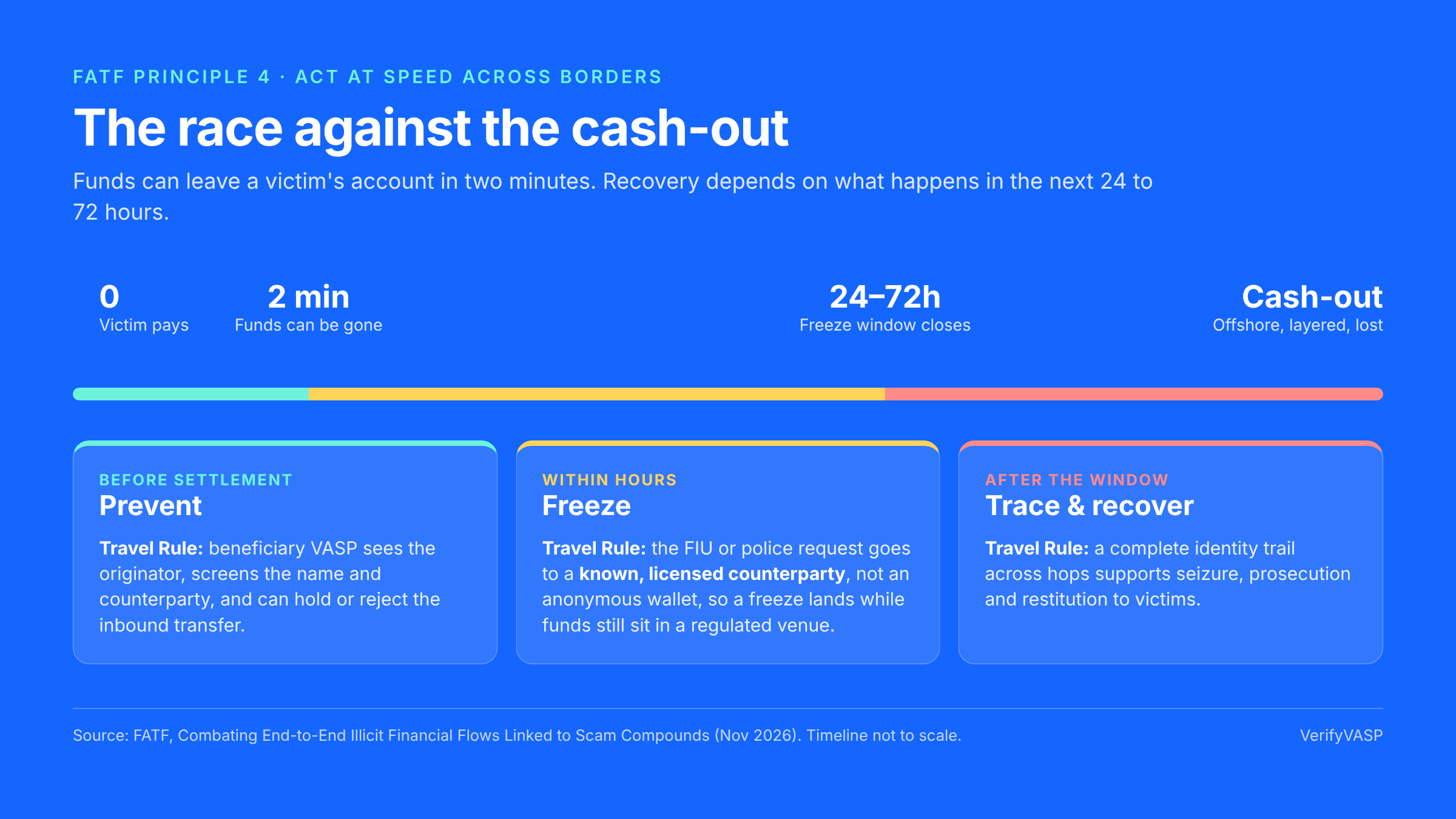
The report also finds that countries are currently better at downstream action, such as targeting victim payments and tracing assets, than at upstream disruption. The Travel Rule serves both ends:
• Pre-transfer: the beneficiary VASP sees who is sending and can hold or reject a suspicious inbound payment.
• Within hours: an FIU or police request can be routed to a known counterparty, not an anonymous wallet, so a freeze can land while funds are still in a regulated venue.
• Afterwards: a complete identity trail supports seizure, prosecution and restitution.
The proof that speed works is in the report's own case studies. Indonesia's Anti-Scam Centre blocked more than 515,000 accounts and returned about USD 10.9 million to victims between November 2024 and May 2026. A US interagency strike force operation led to the voluntary freezing of more than USD 3.8 million in virtual assets.
From compliance to disruption
The FATF will work with the public and private sectors until February 2027 to identify scalable solutions to cyber-enabled fraud. The Travel Rule is part of that conversation.
For VASPs, Travel Rule is not another reporting burden, but a live infrastructure that offers financial crime intelligence and already connects key stakeholders across borders to fight fraud.
For regulators and FIUs, it means building fast, lawful channels to request and act on that data inside the 24 to 72 hour window. At VerifyVASP, this is the work we do every day with VASPs, FIUs and law enforcement. We are committed to joining the global fight against fraud by turning promising tools into interoperable, scalable and demonstrably effective responses.